Figure 18-1 · Chapter 18
The Leader's Emotional Overspray, Residue, and Echo
What you leave behind after every moment — and how it echoes long after you leave the room.
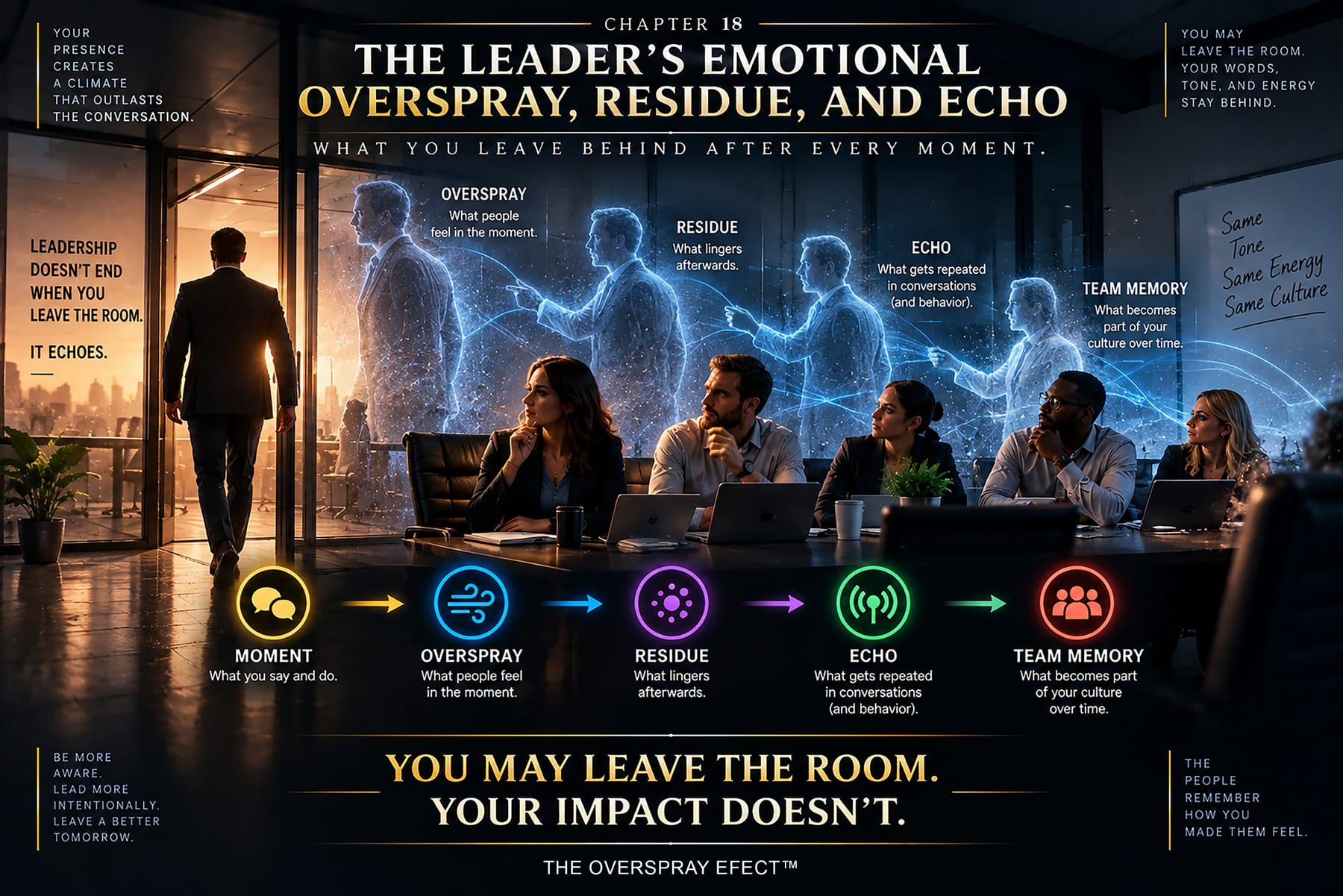
A single leadership moment doesn't end when it ends. It leaves residue — how it actually felt — and that residue hardens into an echo: the story people quietly tell themselves about what it meant. The last ten seconds of an interaction shape that echo more than the first ten minutes do.
How it works
The Moment is the interaction itself — a check-in, a correction, a passing comment. Overspray is whatever unintended emotional charge leaks out of that moment beyond its actual content. Residue is what that charge leaves behind in the room — a lingering tension, or just as often, a lingering calm, depending on how the moment was handled. Echo is the narrative people build on top of that residue to make sense of it afterward — 'they're upset with me,' or 'that felt steady' — a story that often outlives the accuracy of what actually happened. Team Memory is where enough repeated echoes settle permanently — not as a record of events, but as an accumulated sense of what this leader is like, which shapes how every future moment with them gets read before it even starts.
In practice
A leader ends a tense budget call thirty seconds late and visibly rushed, with a clipped 'we'll pick this up tomorrow.' The residue: a flat, uneasy feeling in the room. The echo, built overnight by three different people independently: 'something's wrong and we're not being told.' None of it was true. By the next morning, Team Memory had already filed away one more data point about this leader under 'something's always about to go wrong.'
Something to sit with
Think about how you ended your last few interactions, not how you started them. What residue do you think you're actually leaving behind in the last ten seconds — and what echo is that building?