Figure 19-1 · Chapter 19
Leadership Gravity
Your presence shapes people, culture, and outcomes.
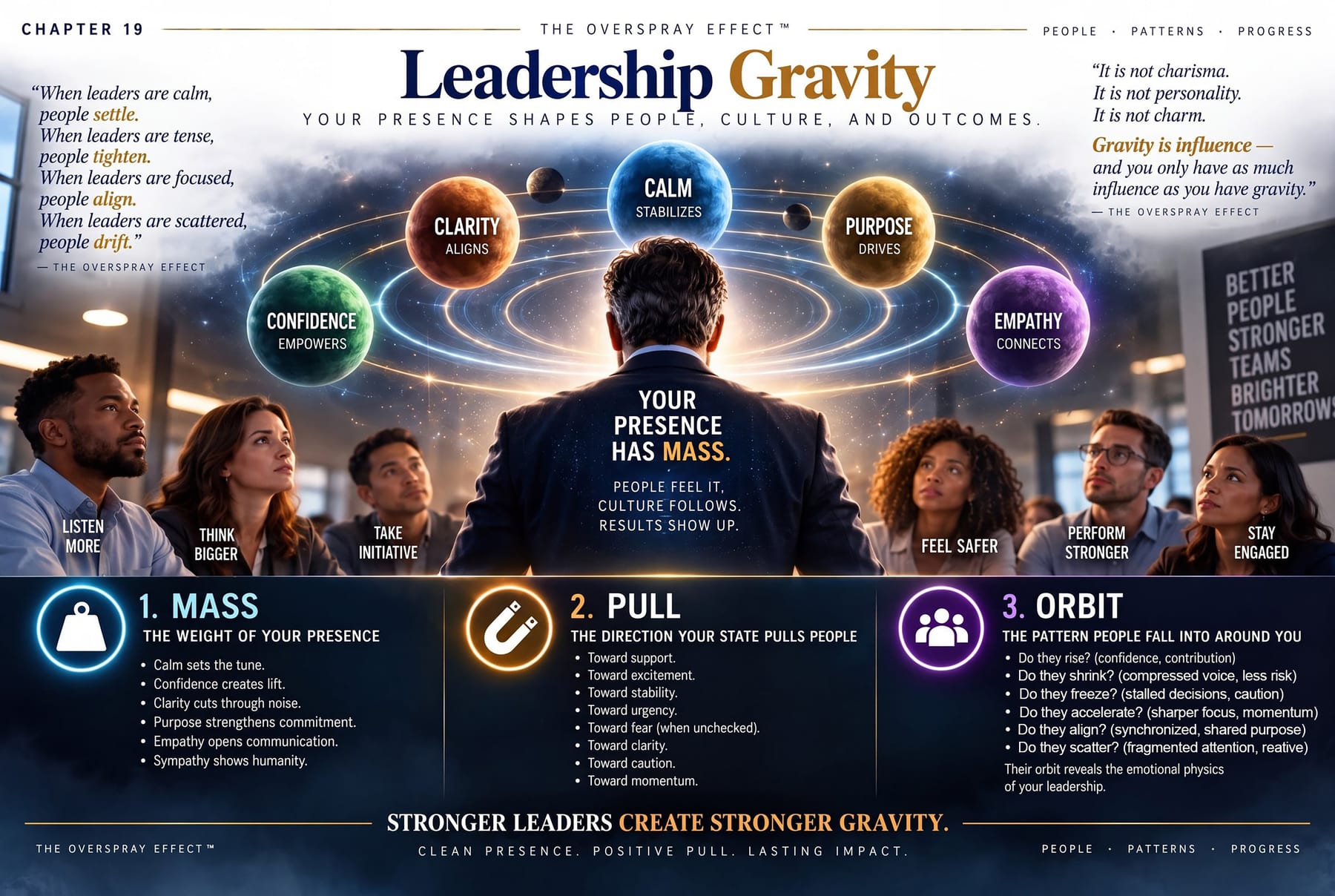
Presence behaves like gravity — it has mass, it pulls in a direction, and it produces a predictable orbit in the people closest to it. A leader doesn't have to do anything dramatic for this to be true. Calm, confident, clear presence stabilizes an orbit. Unregulated presence distorts it — and the people standing closest feel the smallest shifts the hardest.
How it works
Mass is the weight of what a leader actually brings into a room — calm, confidence, clarity, purpose, empathy — the raw gravitational substance of their presence. Pull is the direction that mass draws people toward: support, urgency, stability, fear, momentum, caution, depending on which mass elements are actually showing up. Orbit is the behavioral pattern that pull produces in the team — some rise to meet it, some shrink back from it, some freeze, some accelerate, some scatter — a predictable response to a specific gravitational field, not a random mix of individual choices. The tighter the orbit — the more a team depends on this one leader for direction — the more even small shifts in mass get felt and amplified by everyone circling it.
In practice
A new executive known for steady, clear presence walks into a tense cross-team meeting. Without raising her voice or making a single dramatic statement, the room's energy visibly settles within minutes — her mass pulls the room toward stability, and the team's orbit shifts to match it. A different leader with the same words but scattered, anxious presence would pull the exact same room toward urgency and caution instead. Same agenda. Different gravity.
Something to sit with
If your team's current 'orbit' — how they're behaving around you right now — is a direct readout of your gravitational pull, what is that orbit actually telling you about your mass this week?