Figure 10-1 · Chapter 10
The Overspray Audit
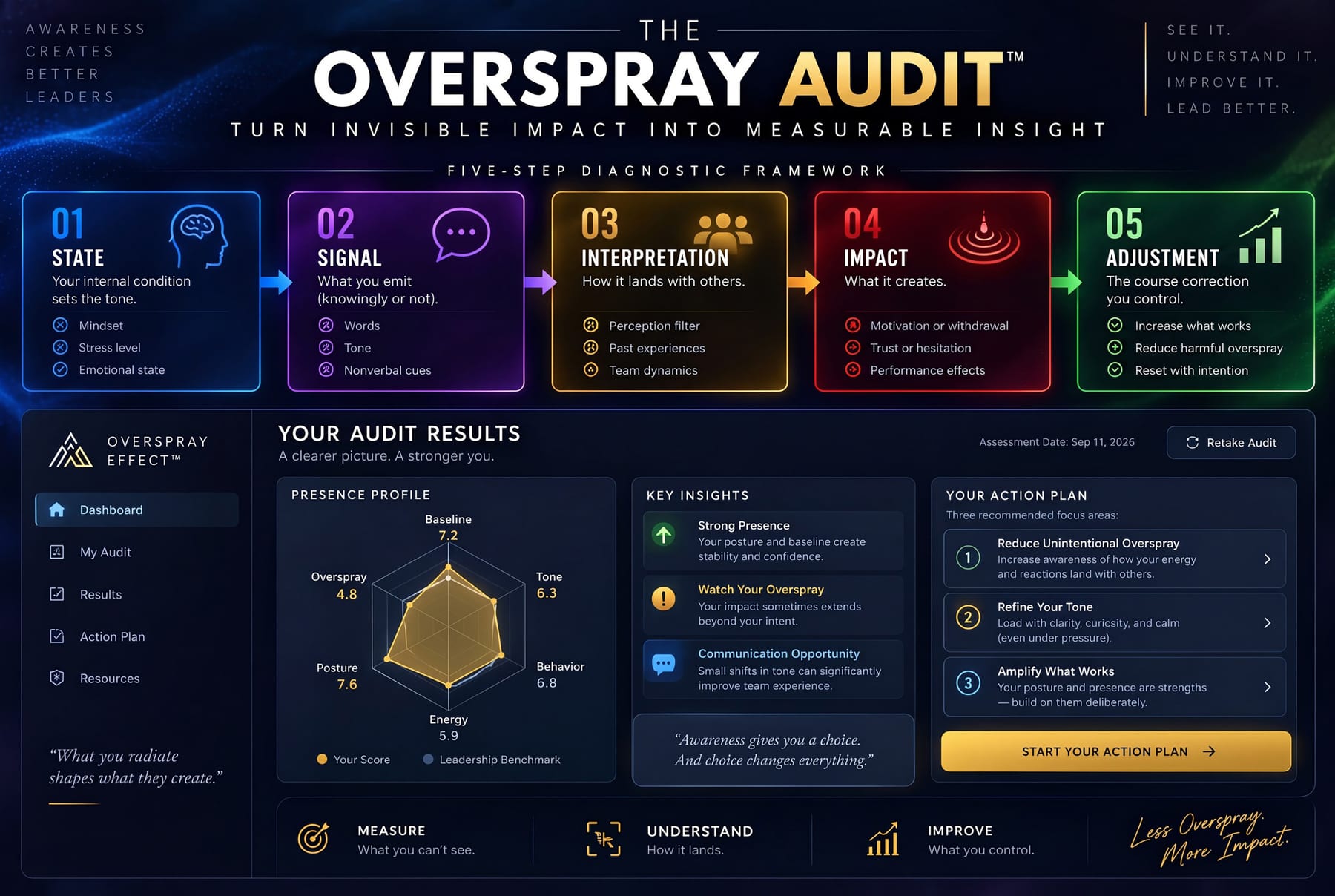
The diagnostic from the book — take the real, scored version free, online.
 View full size ↗
This is the diagnostic from the book. The real, scored version is free, takes about five minutes, and gives you your own results — not just the diagram.
A five-step diagnostic that turns a single leadership moment — a meeting, a hard conversation, a tense decision — into traceable data: your internal state, the signals you actually sent, how your team likely interpreted them, the impact that created, and the adjustment everyone quietly made in response. It replaces "I think that went fine" with an actual chain of evidence you can walk back through.
How it works
The chain runs State → Signal → Interpretation → Impact → Adjustment, and each link sets up the next one. Internal State is what you were actually feeling and carrying into the moment — rushed, frustrated, confident, distracted — not what you intended to project, which is almost never the same thing. Signals are the tone, pace, facial expression, and body language that state produced, whether you meant to send them or not; they travel faster than your words. Interpretation is the meaning your team assigned to those signals, filtered through their own history with you, the team's current stress level, and whatever else is happening that day. Impact is the measurable result of that interpretation — trust up or down, clarity sharper or foggier, energy higher or lower, questions asked or swallowed. And Adjustment is the behavior change everyone quietly makes afterward — the thing people do differently next time without ever naming why — which is where culture actually gets written, one unremarkable moment at a time.
In practice
After a tense client call, a VP realizes his clipped replies in the follow-up team meeting got read as frustration with his own staff, not the client who actually caused it. Trust dropped a notch, and two people spent the rest of the week over-explaining routine updates to him, just in case. Running the Audit on that one meeting shows him exactly where to intervene next time — at the signal, before the interpretation ever has a chance to form.
Something to sit with
Pick one real moment from this week that didn't quite land the way you wanted. If you walked it through State → Signal → Interpretation → Impact → Adjustment, where would the chain actually start — and is that the part you'd normally think to examine?